

Doc, What Is Your Problem?
Don't You Want to Be Like Dr. Bud Dass?


I used to run through this little song and dance during lectures from St. Petersburg to St. Louis to San Jose. The beat might’ve been a little different, but the tune was always the same.
“Raise your hand if you screen all your patients for oral cancer.”
Every hand went up. Every time.
Then I’d query, “How many of you have detected a lesion in the past 12 months?”
Hands dropped fast. In a room of 30 dentists, maybe two stayed up.
“Keep your hands up if you’ve seen more than one squamous cell carcinoma in the past 12 months?” The final two hands went down.
So, I’d ask, “Why are you screening every adult patient for something that affects such a tiny fraction of the population, like, waaay less than 1%?”
The attendees turned into carnival barkers shouting over each other:
“We’re in the mouth already, so it make sense.”
“We care about our patients.”
“It can save lives.”
“It’s the standard of care.”
Everything they said made total sense, and I told them as much. They all righteously nodded and knowingly looked to each other thinking, We got this dumbass.
After a pause, I continued, “How many of you screen all your adult patients for sleep disordered breathing?”
Out of those thirty participants, maybe three hands would go up.
“How many of you who screen have ID’d at least one sleep disordered breathing patient in the past year?”
Unsurprisingly, all three hands stayed up.
“How many of you have found five in the past year?”
They laughed and a guy sitting in the back of the room in a perfectly coordinated kelly green outfit blurted out, “I saw five yesterday.” Everyone looked back at him in awe…or maybe it was the fact that he was dressed like Tommy Bahama entered the popsicle market. I asked his name.
“Dr. Dass. Dr. Bud Dass.”
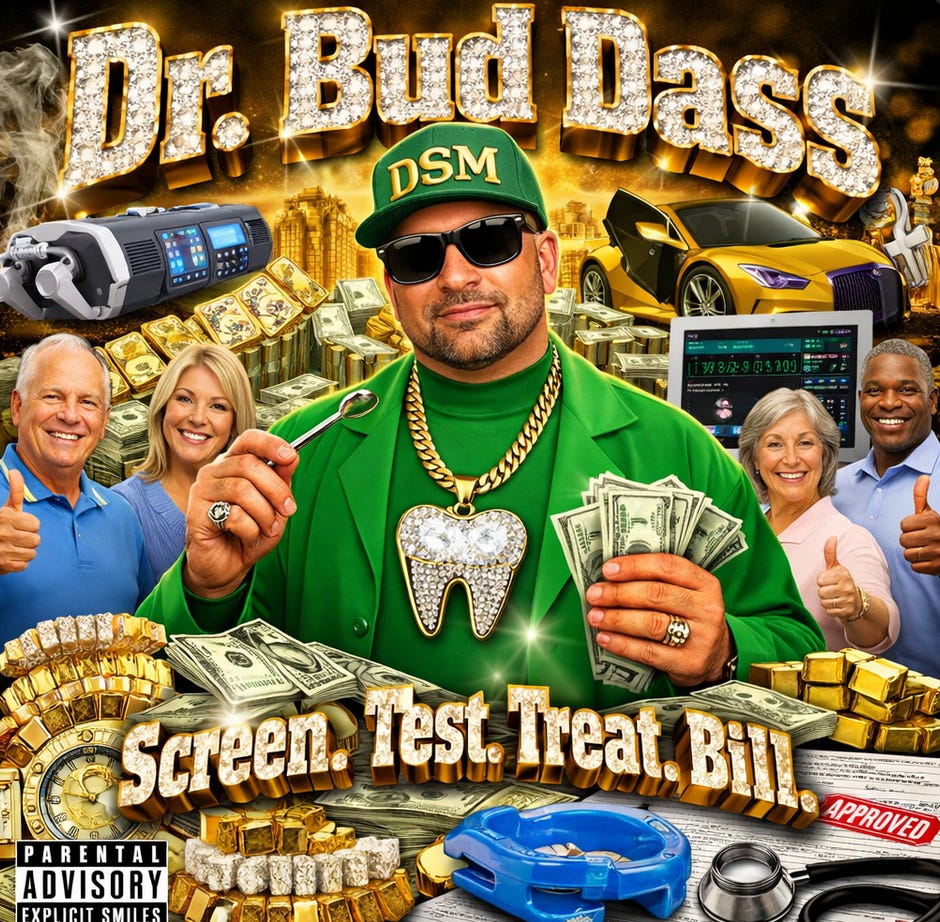
Meet Dr. Dass, Dr. Bud Dass
I took a drink, walked the width of the room for dramatic effect, and returned my attention to Dr. Dass. “Dr. Bud Dass, why do you screen all of your patients for sleep disordered breathing?”
“Shoot, it just makes sense. We’re already in the oral cavity. It’s the standard of care in our practice. My patients are everything to me, and if untreated, OSA contributes to increased risk of heart attacks, stroke, dementia, car crashes. Once you see this, you can’t unsee it. And if I don’t do something about it, what’s that say about me? It’s a damn no-brainer.”
I planted myself in the middle of the room and could feel all the eyes on me. Even though I knew this information forward and backward, public speaking always turns my armpits into my very own personal Everglades. This is why I always wore a suit and tie or a sweater when lecturing.
I started, “Dr. Bud Dass, everyone in here screens all of their patients for oral cancer, a terrible disease that afflicts far less than 1% of the population. 90% of the people in here have never detected a lesion, and the 10% that have, have only seen one in their careers. And they do it because they’re in the oral cavity already, they care about their patients, it’s the standard in their offices—” Again I paused. “But only 10% of the medical professionals in here are screening for OSA despite the fact that at least 1 in 4 people suffer from it, the signs can be seen in the oral cavity, it’s the standard of care according to the ADA, and you all care about your patients, or at least that’s what you said earlier.”
Silence…and not the kind that stems from confusion or bewilderment.
It was like the final scenes in Usual Suspects when Chazz Palminteri flashes back and he realizes that Kevin Spacey’s character is actually Keyser Sozé. Their collective mind’s eye was like a View Finder rapidly flipping through every hygiene check from the previous week:
HBP meds.
Big ass tongue.
Broken crowns.
Battered uvula.
Fell asleep and snored during crown prep.
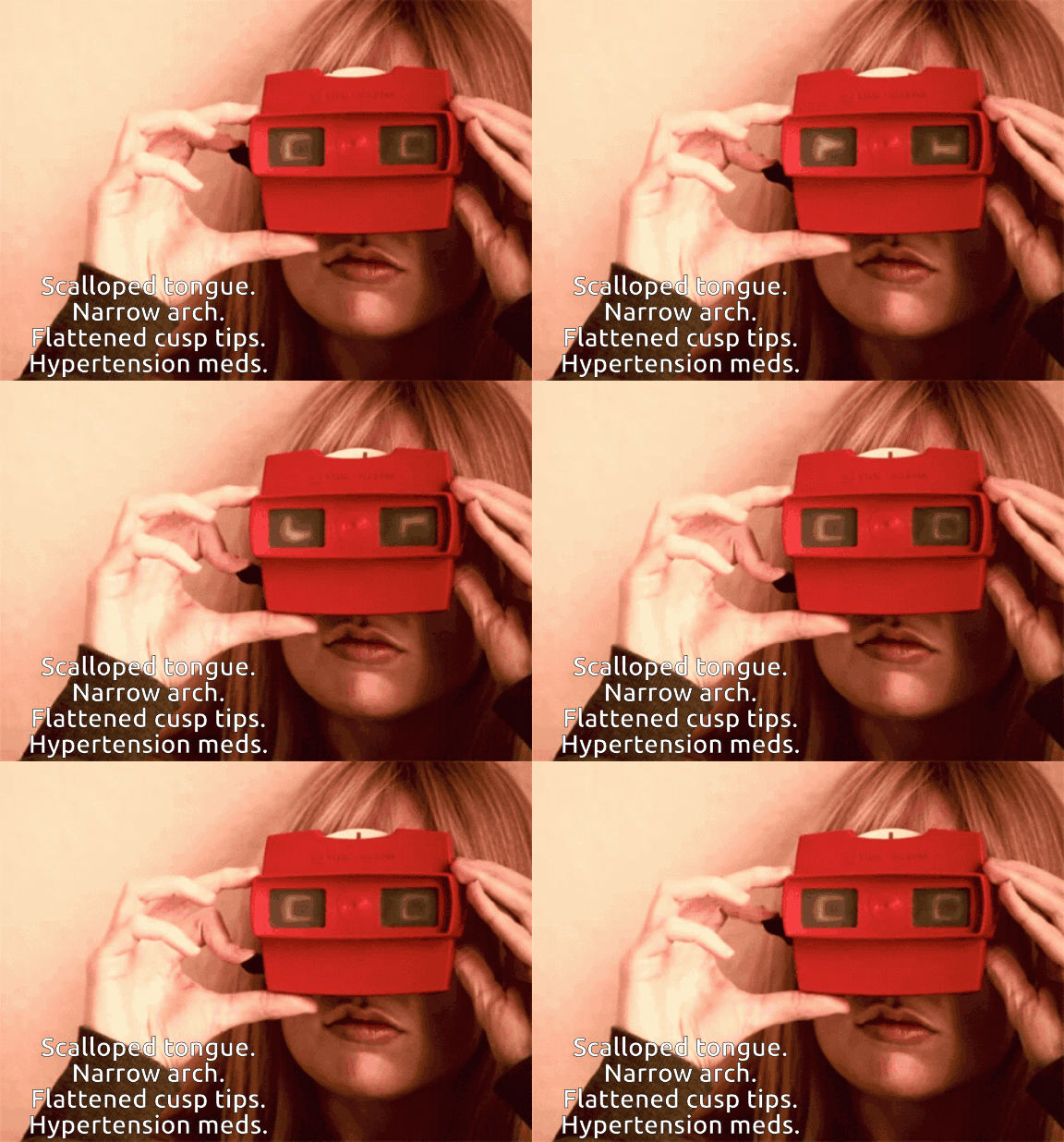
I let them sit with the discomfort of this new reality for a few more seconds. “To the three or four of you screening everyone, are there any other reasons you do it?”
Silence. Again.
I looked around the room slowly, being sure to make eye contact with every person in the room.
“Anyone? Bueller…Bueller…”
Some kind of garbled murmur came from somewhere in the middle of the room. It sounded like she said, “munjun.” I wasn’t sure if it was another language or gibberish, so I asked, “I’m sorry, what was that?”
The silence persisted. “Sorry, I heard someone over in this direction say something, but I didn’t hear exactly what it was. What’d you say”, I asked.
Silence.
After what felt like 2 hours, Dr. Bud Dass broke in like he’d been waiting his whole life for this moment. “Money”, he exclaimed. It was like a dam had broken. “Treating sleep patients is the most freakin’ rewarding thing I do. Seeing patients lose weight and get healthy is the reason I do it, but I ain’t gonna lie, the collections are sweet, too. It pays really well. It’s less physically taxing than implants. People are happy. They wanna see me. Yeah, insurance is a pain in the ass, but when you figure that out, it’s mostly great! It pays really good, and my team does a lot of the work.”
He laughed at his own comment and looked around the room. Everyone was looking at him like he was dressed in a kelly green outfit at a dental sleep medicine meeting. He was.
And while his fashion sense was wrong, his view on the topic du jour was spot on accurate.
The Weirdest Thing About Dental Sleep Medicine
Name a profession where the aim is to lose money. In practically every walk of life, making money is a sign you’re doing something right. Brewster’s Millions is a notable exception.
Baseball players rock diamond earrings the size of baseballs.
Tech founders don’t hide their profits (except during tax season).
NBA players exit the clubhouse in furs and designer gear before driving off in zillion dollar sports cars.
Some rappers can’t drop two bars without mentions of mansions, millions, and monogrammed minks.
Even nonprofits can’t exist without bringing in the dough.
But in dental sleep medicine the desirable margins and potential for profit are like 4 letter words during a church service.
Patient care and altruism must come first. Without those as your primary drivers, you’re just a greedy creep. However, you can focus on doing the right things the right way and for the right reasons AND STILL make money doing it.
That’s not a crime. That’s not deplorable.
That’s being a smart businessperson.
Let’s Be Honest for a Second
Dentistry is first and foremost about delivering exemplary patient care.
It’s also a business.
Those can both be true. In actuality, they reinforce one another.
The healthiest DSM practices treat thousands of people every year. They help those patients so they are able to sleep better, so they can get off of meds, so they can lose weight, regain energy, rejoin their spouses back in bed, and play wiffle ball with the grandkids.
And they’re realizing the resultant revenue. They aren’t gaming the system. They aren’t scheming or taking advantage of anyone.
And they aren’t dabbling.
They’re committed…to their patients, to their practices, and to the profession.
They’ve established goals and trained teams.
They’ve cultivated physician referral relationships and built systems.
They market these procedures, and they’re unafraid—proud even—to let their communities know this is what they do.
And yeah, they make money.
In some cases, tons of it.
Because they’re delivering real value.
The Mirror Test
Strip away the professional pressure to get into this.
Why are you interested in Dental Sleep Medicine?
Be honest. No audience. No applause.
No Dr. Bud Dass. No strategically placed pauses to allow you to feel shame courtesy of yours truly.
Just you and the mirror.
Force-rank your real motivations:
Help patients
Standard of care
Intellectual interest
Increase revenue
Personal connection
Differentiate your practice
Something else
If #4 is your #1, you won’t last. You’ll flounder, get frustrated, and finally bail. Just ask the DSOs that abandoned DSM years ago.
But if #4 isn’t one of your drivers, you’ll never fully commit.
Why would you? Your practice is a business. And without commitment, this doesn’t work.
Steven Pressfield said it best, “The professional takes money. But in the end, he does it for love.”
Does that sound like you? You do this because it matters. You do it because patients need it and because you can change lives. And lastly, when it’s done the right way, for the right reasons, it’s a really damn good business.
So What? Now What?
You can save lives and make a lot of money.
If that sentence makes you uncomfortable, read it again.
Dental sleep medicine isn’t the problem. And money isn’t the problem.
That unease, that discomfort? That’s the problem.
Listen, I’ve talked with thousands of dentists over the years. Almost every one of them made their first foray into DSM for the right reasons. But do you know why they all quit? It isn’t because devices don’t work or due to exorbitant chairtime.
Nope, it was because of money; specifically, the lack of it. Dabblers don’t earn. They don’t cash out. They burn out.
It’s funny. Everyone acts like it’s a crime to make money. Then they quit because they don’t make money. Then patients get left to wander the hinterland undiagnosed, untreated, and unhealthy. What’s the real crime here?
If you’re going to do this, do it right.
Screen consistently.
Build relationships with physicians.
Develop your team.
Implement repeatable workflows.
Don’t dabble. That’s a waste of time and energy.
Commit. Because the patients are already in your chair and they need you.
The opportunity is already there. It’s here. It’s now. Take action.
Exactly
👏👏👏