

If you’re like me, you have shelves of books. Crowded together are heirlooms, gifts, books from friends who are authors, self-help, textbooks, and those I hoped would teach me some skill or another. Significant shelf space is devoted to the ones I’ve not yet read. One wonders why I have a library card or a stack of vinyl I’ve similarly left unrequited for my attention.

You may not have heard of the three books that are the subject of this essay. They are important to me, helping me realize what I didn’t know, but wanted to learn. And share.
I recently found these words by Professor Sarah Lewis, which I’ve read over and over:
“Mastery is about being a student of the game. When we achieve some level of confidence about our competence, we want a new climb— a new challenge. We seek out the feeling of ‘not quite.’ We seek to experience the sense of incompleteness, so we have something to charge after in passionate pursuit.”
Book One: Big Magic by Elizabeth Gilbert
Not a book about sleep, or dentistry, or medicine. At least, not with any of those as specific subjects. This one is about living to your possibilities, enlarging your world, and minimizing fear that might be holding you back.
Professional medical education, other than specific sleep fellowship, provides very little information about recognizing and treating people with sleep problems, including sleep related breathing disorders. Every medical professional must seek the new challenge of adding a whole area of complex physiology to their expertise. Each of us can only learn from our base of knowledge – dentists learn from a craniofacial respiratory complex expertise, neurologists from brain science, rhinologists from nasal structure and function, etc. Knowledge changes our ability to recognize details in our patients’ stories we could not perceive before. Addressing challenges may require new treatment strategies, new systems, new equipment, maybe even new co-workers. Fear of change is real. So is an attitude of ‘I can’t do that’ for many reasons: real, imagined, and assumed.
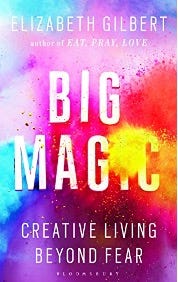
Elizabeth Gilbert names areas of growth, beginning with Courage - we all defend our fears until we realize how much they hold us back. She writes “the clock is ticking, the world is spinning, and we simply don’t have time any more to think so small.” Once we can dismiss this constraint, our world opens to Enchantment – the fascination we get with a subject so compelling that we lose ourselves in the flow of pursuit. Ideas insist themselves upon us, and we give them Permission to sit beside us. Even when we find ourselves pushing back, the magic Persists, because we also realize we can’t return to the fear-based life we set aside. Success breeds Trust in ourselves, the process, and the magic that surrounds us. Soon, our routine actions align with a purpose that was unforeseen with a closed, fearful mind and the world is new. You no longer have ‘patients,’ but, rather, people seeking care for mysterious afflictions. They see the magic in your face, feel the trust you project, and find ways to share their story. The tale they tell is another idea, claiming space in the relationship, another instance of Big Magic.
Book Two: Empowered Sleep Apnea, a Handbook for Patients and the People Who Care About Them by David McCarty MD FAASM and Ellen Stothard, PhD
You will be surprised at this one. How many textbooks did you use during your education that were illustrated with original cartoons? That framed vital education with stories, from the perspective of a character, that used metaphor to teach physiology? If your answer is ‘none, of course,’ you are the reason Dave and Ellen created the ‘Big Blue Book.’
I interpret the subtitle as the first metaphor. The medical professional learns to take the perspective of both experts – the patient and the doctor. When trained in a narrow field, we can forget what it is like to not know critical information. Only by trying to see things as the ‘lay person’ might see them can we muster sufficient empathy to join them in the journey. A storytelling structure provides space for the medical professional to meet them where they are and have an adventure of discovery together. Along with the science, facts, and physiology, there is a tremendous amount of sleep medicine to learn in the Big Blue Book.
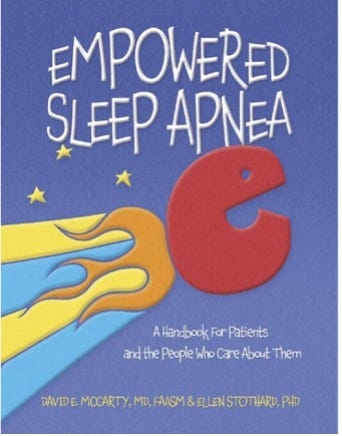
Dave McCarty, an English major, is a storyteller and musician with a medical degree and sleep fellowship. Effective educators know that engaging more senses yields better teaching/learning than appealing to only a few senses. Pick up a textbook, read a journal article, sit in a lecture and one or two senses are involved. Following Claudio through the Isle of Sleep Apnea engages the imagination. Stand on the bottom step of the Five Reasons Monument and Coffee Hut and allow the image to embed within you the tools you need to meet your patient’s needs. Before you write this book off because it has ‘cartoons’, tell me, ‘What’s the point of education except to effect change in the learner that benefits community health? Can we recognize the feeling of ‘not quite’ and pursue other magic that awaits us?’ Explore their personal Isle of Sleep Apnea with them and enjoy the journey!
Book Three: If I Understood You, Would I Have This Look on My Face? My Adventures in the Art and Science of Relating and Communicating by Alan Alda
Yes, the author is that Alan Alda. An unexplained dental surgery is the genesis of this book. The imperfect outcome, in the mind of this creative and committed communications expert, was the perfect reason to bring a message of clarity to science. The somewhat goofy, endearingly crooked grin we’ve seen on one of the most popular actors of his generation is yet another ‘Yes, and’ launch point in the quest to transfer specialized knowledge from those who possess it to those who need it.
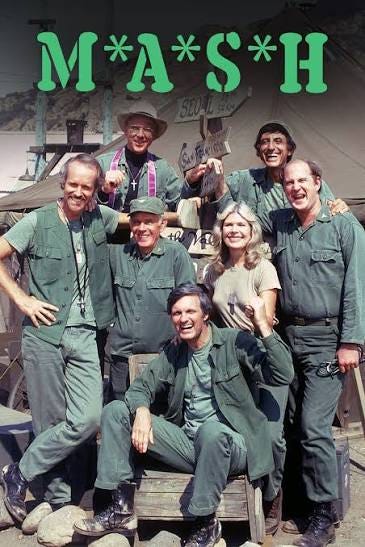
Your training provided knowledge in your special area of medicine that few others have; because of your uniqueness, perhaps it is accurate to say ‘no one else’ has. The person in your office is similarly unique, having concerns, worries, life experiences no one else has. All of us have lived through countless lessons in communication, or lack thereof, that resulted in unforeseen effects, vowing to not let that happen again, only to re-live it the next time. What breaks this cycle? Listening. Reducing jargon by checking for common understanding. Searching for language outside your narrow area to match the scene partner you are sharing with.
“Scene Partner?” In the world of improvisational acting, there is one skill that supports success: listening. On stage, without a script, scene partners must listen for clues where to take the story as it unfolds in real time. In your clinic, neither you nor your patient has a script; if either of you stops listening, the tar pit of poor communication entraps. You cannot fully control how your patient listens, but you can see in their body language and hear in their responses whether they are engaged. Since you and your team have learned to be attentive, you can bring them back into the encounter using the right questions.
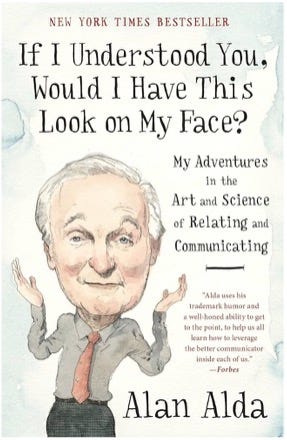
Alda’s book tells stories of theoretical physicists able to make their passion accessible. Narrowly trained experts, coached by a communication master, bring an audience into their world using metaphors and other skills. What’s a particle except a loaf of bread that’s been divided in half over and over until it cannot be further divided?
When your patient says ‘Doc, I’m snoring’ and you ask about blood pressure, the scene ends. When you say “CPAP,” their face drops, and you talk about ”gold standard,” the scene ends. Listening skills allow the scene to come to a natural conclusion, smiles all around, with commitment by both scene partners to move on to the next part of the story.
Alda’s witty and entertaining style lays out the imperative for better ways to share knowledge with each other. Stories, skills, and pathways to success greet the reader. It takes courage to meet your patient scene partner, trust the process, and persist in the adventure with them.
Honorable Mentions:
If you’ve not read Breath, what are you waiting for? Ken Berley and I wrote The Clinician’s Handbook for Dental Sleep Medicine to provide critical education for dental teams. The second edition has chapter contributions from physical therapy, myofunctional therapy, nasal function, and breath coaching. Brave Parent, Dear Momma, and Breathe, Sleep, Thrive are excellent resources for young families. My Dog Myo and My Nose and The Nose Rules help with the vital role nasal function has for healthspan. There are hundreds of ideas out there, waiting for an invitation.
Steve Carstensen, DDS, FAASM owns Seattle Sleep, a practice dedicated to dental sleep medicine. He is an accomplished author, prolific speaker, an audiophile, and he’s always open to hearing your thoughts about Oxford commas.

LOVE Elizabeth Gilbert...great book AND her book, "All the Way to the River". Great story about love, addiction and just life in general. Empowered Sleep Apnea...great book AND his podcast reminds me of Reading Rainbow as a kid! SUCH a great story teller!
THANK YOU Dr. C
M.A.S.H is truly a classic for sure.
I would also add Transform Dental Sleep 💪🏻